1. Swindpy

1.1. Motivation
Magnetic clouds (MCs) are highly magnetized plasma structures that have a low proton temperature and a magnetic field vector that rotates when seen by a heliospheric observer.
As motivation MC are the most geo-effective structures in the Interplanetary medium. Even though MCs have been studied for more than 25 years, there is no agreement about its true magnetic configuration. This is mainly because the magnetic field data retrieved in situ by a spacecraft correspond only to the one dimensional cut along its trajectory and, thus, it is necessary to make some assumptions to infer the cloud 3D structure from observations. Magnetic Clouds have been locally considered as cylindrical symmetric structures. In order to obtain good estimations of these quantities, it is necessary to find the correct MC orientation, and improve the estimation of its size and components of B in the cloud frame.
The Minimum Variance method (MV) has been extensively used to find the orientation of structures in the interplanetary medium.
The Minimum Variance method applied to the observed temporal series of the magnetic field can estimate quite well the orientation of the cloud axis, when the distance between the axis and the spacecraft trajectory in the MC (the impact parameter, p) is low with respect to the cloud radius.
The MV method has two main advantages with respect to other more sophisticated techniques that are also used to find the orientation of an MC: (1) it is relatively easy to apply, and (2) it makes a minimum number of assumptions on the magnetic configuration, only local cylindrical symmetry (so it is model independent).
When p is significant,the MV approach provides orientations with more error from the real ones, and these errors can be estimated as well
1.2. Requeriments
* Python 3.9+
1.3. Dependencies for this project
1.4. Installation
$ pip install swindpy
1.5. Tutorial
In this tutorial we are going to learn how to rotate a Magnetic Cloud using the swindpy abstractions.
First of all, we need to set the datetimes we are interesting in:
from datetime import datetime

import matplotlib.pyplot as plt

import swindpy.plotter as plotter
from swindpy.data_manager import Period, MagneticField, DataManager
from swindpy.rotation import RotatedWind
For this example, we are going to use this dates: 10-Jan-1997 05:00 to 11-Jan-1997 02:00
# We set the datetimes we are interesting in
date_from = datetime(1997, 1, 10, 5, 0, 0)
date_to = datetime(1997, 1, 11, 2, 0, 0)

# We create the Period object
period = Period(date_from, date_to)

#Using the DataManager, we retrieve the cdf information
cdf_data = DataManager.get_gse_magnetic_vector(period)
The obtained data, is a list o MagneticField objects (a swindpy abstraction), that has information about the datetime and the gse coordinates measures.
cdf_data[0]
MagneticField(time=Timestamp('1997-01-10 05:00:30'), bgse0=-1.8067849, bgse1=9.860464, bgse2=-8.717464)
Now, using the DataManager, we are able to filter nan and infinite values.
filtered_data = DataManager.filter_nan_and_inf_values(cdf_data)
Now we can obtain the RotatedWind simply calling a classmethod
rotated_wind = RotatedWind.get_rotated_wind(filtered_data)
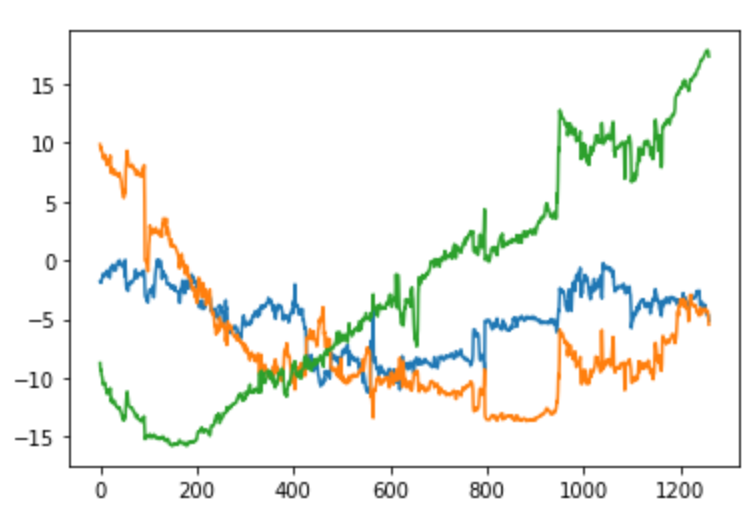
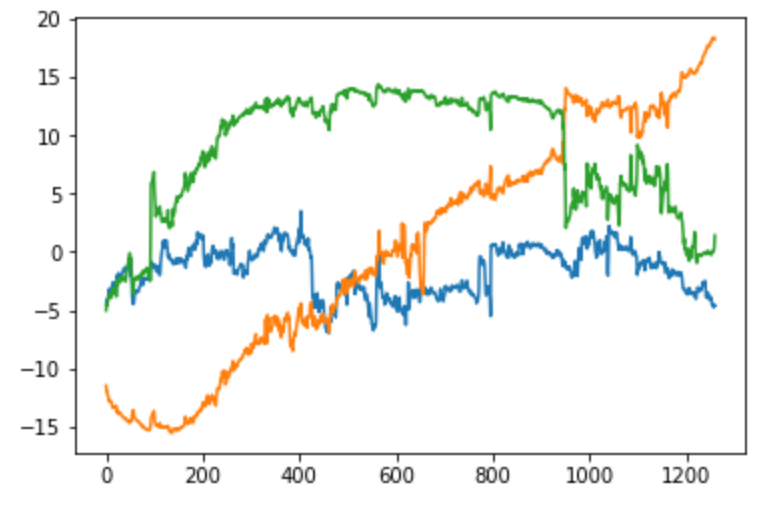
Using the plotter method, we are able to plot non rotated winds and rotated winds (we are also able to add labels, change size, etc).
# Plotting non rotated
plotter.plot_mf(filtered_data)
# Plotting rotated
plotter.plot_rw(rotated_wind)
# Obtain the rotation angles
theta, phi = get_rotation_angles(filtered_data)

# Calculate gamma using calc_gamma
gamma = Angle(
        "gamma",
        calc_gamma(theta.angle, phi.angle)
)

print(theta, phi, gamma)
theta
 RAD: -0.31457481937133086
 DEG: -18.02380949106747
phi
 RAD: 1.6979828788548021
 DEG: 97.28725264385352
gamma
 RAD: 0.31696887828176834
 DEG: 18.160978962541225
Using swindpy command line interface
We also created a CLI that makes it easier to a user to process magnetic clouds data.
If you want to plot a no rotated cloud, you could do that with the next command:
swindpy plot-cloud 2021-01-01 2021-01-02
If you want to plot a rotated cloud, you could do that with the next command:
swindpy plot-rotated-cloud 2021-01-01 2021-01-02
To export data about the Magnetic Fields in a period time, use the next command:
swindpy to-csv 2021-01-01 2021-01-02 output
The previous command will generate a csv with the period data
You are also able to plot both, no rotated and rotated clouds so you can compare and make a quick analysis of the results:
swindpy plot-rotated-and-non-rotated 2021-01-01 2021-01-02
1.6. Tools that we use so far
Tools |
Detail |
Python |
Language |
Pylint |
Syntax |
Pypi |
Publish the library |
Sphinx |
Keep record |
Github |
Share the code |
readthedocs.org |
Publish documentation |
1.7. Contact
You can contact us via email, agulisano@iafe.uba.ar
1.8. Issues
Please submit bug reports, suggestions for improvements and patches via the issue tracker.
1.9. Links
1.10. Credits
We propose to use the open source software Solarwindpy using for the calculation the Minimum Variance Technique to obtain the orientation of magnetic clouds provided the correct cloud edges are provided.
1.11. License
The four essential freedoms
A program is free software if users have all four essential freedoms:
The freedom to run the program as desired, for any purpose (freedom 0). The freedom to study how the program works, and change it to do what you want (freedom 1). Access to the source code is a necessary condition for this. The freedom to redistribute copies to help others (freedom 2). The freedom to distribute copies of your modified versions to third parties (freedom 3). This allows you to offer the entire community the opportunity to benefit from the changes. Access to the source code is a necessary condition for this.
The two main categories of free software licenses are copyleft and non-copyleft. Copyleft licenses, such as the GNU GPL, insist that modified versions of a free program must also be free software. Non-copyleft licenses do not engage in this.
-BSD License (Berkeley Software Distribution):
It is a permissive free software license. In other words, it is in contrast to copyleft licenses, which have share-alike reciprocity requirements. The BSD license allows the use of the source code in non-free software. The original version has already been revised and its variants are called modified BSD licenses.
Copyright <year> <copyright holder>
Redistribution and use in source and binary forms, with or without modification, are permitted provided that the following conditions are met:
Redistributions of source code must retain the above copyright notice, this list of conditions and the following disclaimer. Redistributions in binary form must reproduce the above copyright notice, this list of conditions and the following disclaimer in the documentation and/or other materials provided with the distribution. Neither the name of the copyright holder nor the names of its contributors may be used to endorse or promote products derived from this software without specific prior written permission.
THIS SOFTWARE IS PROVIDED BY THE COPYRIGHT HOLDERS AND CONTRIBUTORS “AS IS” AND ANY EXPRESS OR IMPLIED WARRANTIES, INCLUDING, BUT NOT LIMITED TO, THE IMPLIED WARRANTIES OF MERCHANTABILITY AND FITNESS FOR A PARTICULAR PURPOSE ARE DISCLAIMED. IN NO EVENT SHALL THE COPYRIGHT HOLDER OR CONTRIBUTORS BE LIABLE FOR ANY DIRECT, INDIRECT, INCIDENTAL, SPECIAL, EXEMPLARY, OR CONSEQUENTIAL DAMAGES (INCLUDING, BUT NOT LIMITED TO, PROCUREMENT OF SUBSTITUTE GOODS OR SERVICES; LOSS OF USE, DATA, OR PROFITS; OR BUSINESS INTERRUPTION) HOWEVER CAUSED AND ON ANY THEORY OF LIABILITY, WHETHER IN CONTRACT, STRICT LIABILITY, OR TORT (INCLUDING NEGLIGENCE OR OTHERWISE) ARISING IN ANY WAY OUT OF THE USE OF THIS SOFTWARE, EVEN IF ADVISED OF THE POSSIBILITY OF SUCH DAMAGE.